🔁
Repeatable beats heroic
If a migration depends on the one engineer who knows the quirks, it is not a process. It runs from a queue or it does not scale.



Three convictions from 10,000+ onboardings and migrations. They decide how the work is cut long before anyone opens a data model.
If a migration depends on the one engineer who knows the quirks, it is not a process. It runs from a queue or it does not scale.
The full path is run against real data before go-live, as often as needed. What you approve in the test is what goes live.
The customer is told what moves, what changes and what disappears, before the cutover. Managed expectations survive go-live; promises do not.
Six steps from signature to a running queue. The first four happen once, the last two repeat as each wave forms.
The acquired systems on one side, the platform they are moving into on the other. Read access is enough to start.
Your CRM brings the customer list with owner, value and date, or you upload it. Your roadmap tool, Jira, ProductBoard or Linear, brings what engineering still owes them. Both feed the order the queue takes later.
Tables, relations and the awkward corners become visible from the data itself. No workshop reconstructs what a system does better than its own records.
AI drafts the mapping against anonymised data in your own region. Your engineers approve it, and that approved version is what runs.
Readiness, missing features and your own capacity decide the order. The platform proposes it, you adjust it instead of building it.
Your team works one queue with one structure and the target KPIs in view. Each wave is validated against the target and written to the record before the next one forms.
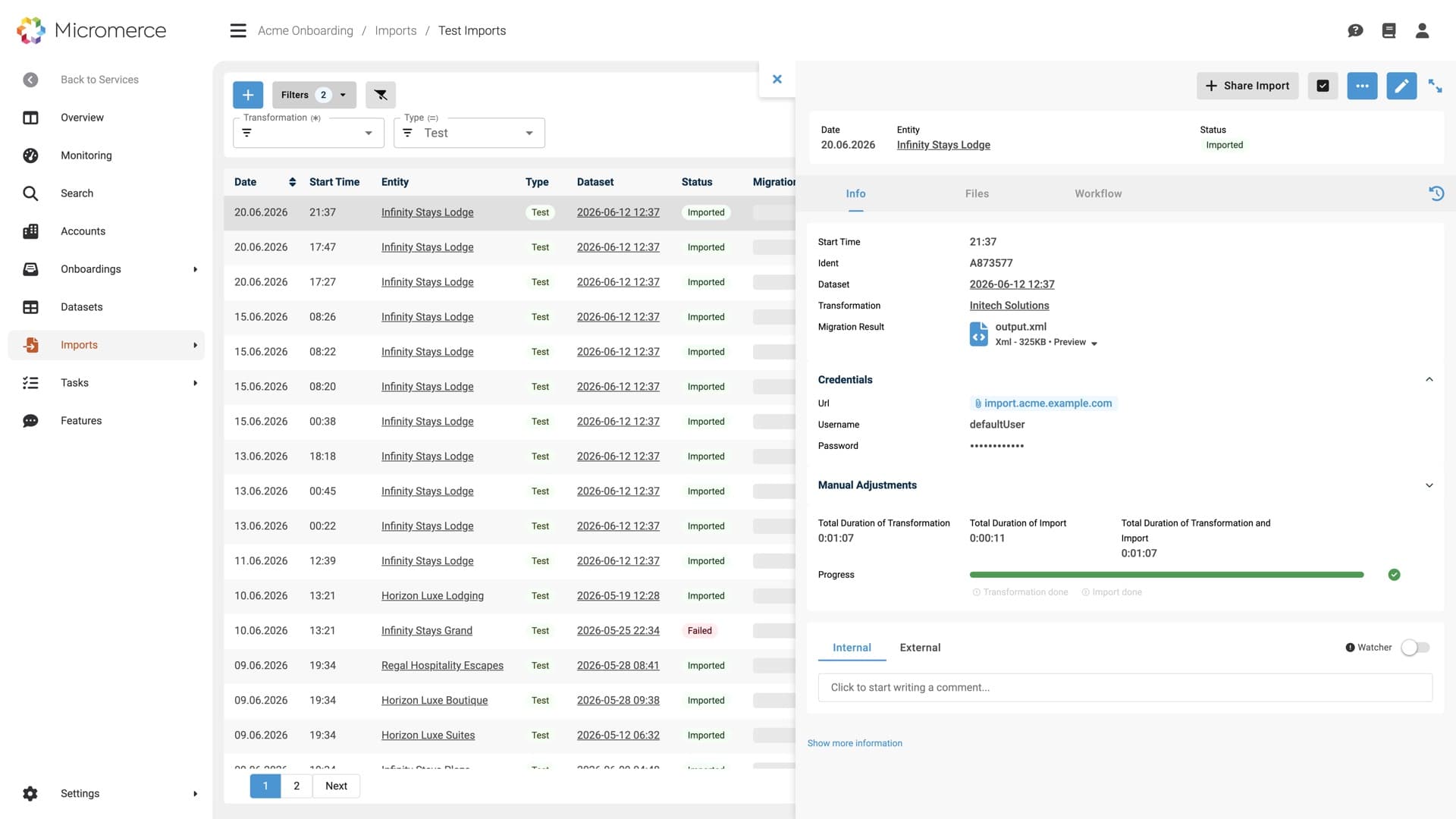
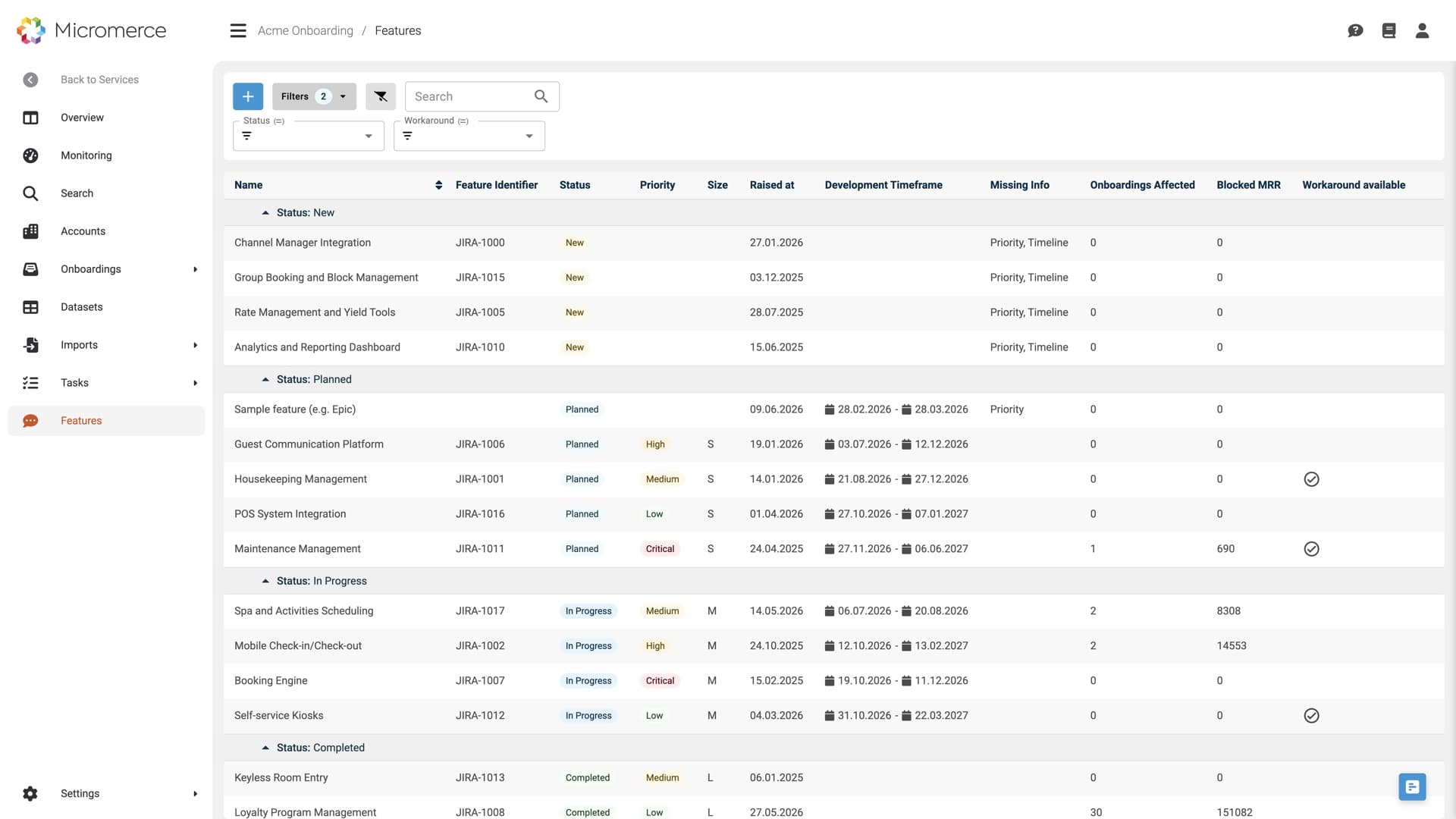
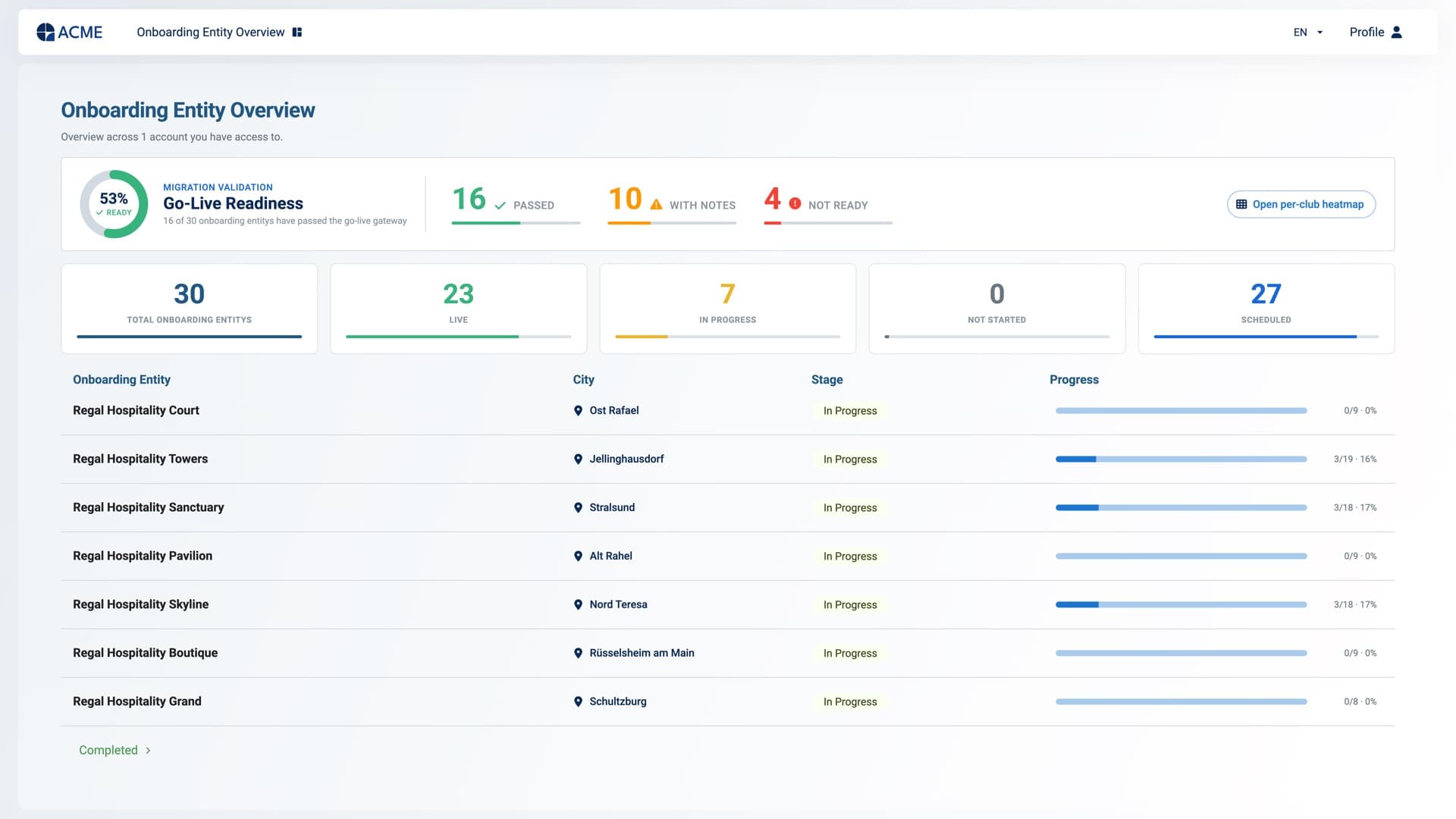
Every headline backed by a concrete workflow. Screenshots show what your team will actually use.
Each acquired platform is a source bucket, mapped into the same target model by the same engine that runs your everyday onboardings. A new customer, a single switcher and a whole acquired base are the same job at different volumes.
After an acquisition the source system is usually yours too. A button or a banner inside it lets each customer start their own migration, and the export goes straight to a secured API. Everything after that runs without you.
30-minute call. Tell us how many source systems are in the way, we walk you through how your own data would order the queue.
Every uploaded dataset shows which features that customer actually relies on. Where the target already covers them, the data puts them in the first wave. Where it does not, you see the revenue waiting on the roadmap.
Every customer is in the queue from the start and is processed automatically, validated against the target on the way. Hand-run migrations stop at a handful. A queue does not care whether it is fifty or five thousand.
The state at cutover is written to an immutable audit trail: timestamped, per tenant, kept for ten years. Whatever anyone asks twelve months later, the answer is still on file.
Anonymised from our customer base. See whether one of them is yours.
Acquired competitor platforms on one side, customers won off rivals on the other. Both meant somebody else's data model had to become theirs.
A repeatable path from any competitor system into the target platform, run often enough that it now sets the standard for the industry.
Three acquired platforms, three data models, one target. Handled separately it would have been three engineering projects with three audit trails.
A triple migration through one engine, with one report format the investment committee could read across all three.
Two customer bases across several countries, each with its own data model, expected to run as one platform.
The bases brought together wave by wave, with the differences resolved before cutover rather than discovered by customers afterwards.
We run acquired-base migration as a flow rather than a project: planned from readiness data, worked off a queue. What each habit earns you closes every card.
Other parts of the platform you'll use alongside this.
That is the normal case. Each system is a source bucket into the same target model, mapped by the same engine, with one audit trail across all of them.
Through a secured API. In an acquisition you normally control the source system, so the cleanest route is a button or banner inside it that hands the export over directly. Where that is not possible, the customer uploads in their portal instead.
You could, one at a time. The difference is the queue: a wave is worked through automatically, customer after customer, with validation on the way. Run by hand, each customer is its own small project, and a base of thousands never finishes.
Yes, and it is the same mechanism. A competitor export is a source system like any other, which turns a bespoke project into a repeatable path.
What moved, what matched, what differed per data type, and the frozen state at cutover. We walk you through a real one on a call.
We connect the platform to your internal systems and run a first export through it. That run shows what the data actually looks like — volumes, structures, the awkward parts — and builds an automatic queue of who can migrate first. The waves fall out of that queue, grounded in your own data, before anyone commits to a date.
30-minute call. Bring an onboarding you are running today, we show you where the time goes.

We use cookies!