Data migration for business software
Customer data out of the legacy system, validated in yours.
A software change should not put the customer record at risk. We connect the sources and draft the mapping, your team confirms the business rules. More than 10,000 onboardings and migrations behind the process.
For you if customer records have to leave a legacy system intact.
Looking for onboarding new customers or moving an acquired customer base?
Where migrations actually fail

Nobody wants to touch the migration. One mistake in the customer data, and everyone knows.
The effort is guessed, not known. So it gets priced high and postponed.
The provider migrates what is easy. The rest stays behind in the old system.
It is nobody's day job. The team learns on your data.
How repeatable are your migrations, really?
The check asks whether a migration that ran once can run again without being rebuilt, and how much of that decides later whether an acquired customer base can be absorbed.
Start the checkUp to 24 questions · about 5 minutes · free
How Micromerce runs a migration
The first migration and the five-hundredth take the same path. No one-off scripts.
Read the source
Databases, files or an API: 20+ data sources out of the box. If it holds customer data, the engine reads it.
Map and transform
AI drafts the mapping, even the ugly ones. Your team reviews and approves it.
Validate in the target system
Every run checks the result in your system and keeps the record. No gut feeling.
Run it again, and again
The approved mapping runs for the next customer. Our engineers take the hard sources: 50+ projects shipped.
Did everything arrive, and is it right?
When the auditor asks about data validation: what is the basis? Where is the result? Where is it frozen? Where can I compare it?
Did every record arrive?
Records are counted per data type and location, source against target. Each location gets a go or a no-go, with the deviation named.
Do the numbers still add up?
Counts and sums are compared between source and target in every test run, so a difference shows up before anyone cuts over.
Can you prove it later?
Every run is logged with time, operator and result. Each test import is a frozen snapshot, immutable on S3 Object Lock for ten years.
What a repeatable migration changes
From projects we run ourselves, not from a model.
Hours
for data migrations that used to take weeks
75%
fewer manual steps for onboarders
2,500+
locations migrated in a single acquisition

The European market leader in gym software on working with Micromerce:
Micromerce helped us accelerate our customer onboarding by up to 50% and significantly improve data migration quality. Their exceptional collaboration and dedication to always going the extra mile have enabled us to achieve our goals efficiently and effectively.

Konstantin Wolkowa
COO - Sport Alliance GmbH
The platform features behind this solution
Each one works on its own. These four do the work here.
Data Migration Engine
Customer records from 20+ data sources into your target system. AI proposes the mapping, your engineers approve.
Security & Compliance
Hardware keys, data anonymised before any model sees it, processing in your own region, and an audit trail behind every change.
Bring Your Own Cloud
The migration runs inside your own AWS account and region. Source files, transformation output and batch jobs never leave it.
AI Control
Ask the Onboarding Agent in the platform, or connect your own AI through MCP. Anonymised, in your own region, and on the record.
20+ data sources
without custom code
Databases, files and APIs out of the box: MS SQL, Oracle, PostgreSQL, Excel, CSV, S3.
The tools your team already works in connect the same way.





FAQs
We have been solving complex software problems for over 20 years and have successfully completed more than 10,000 onboardings and migrations.
Yes, because AI is a tool, not a requirement: you decide where AI is used. Sensitive records are anonymized structure-preserving before any model sees them, so no PII or PCI data ever leaves the source system.
Every migration run automatically produces a check report: record counts, sums and deviations per data type, source against target. Every transformation is also recorded in an immutable, timestamped audit trail, the document your auditor asks for already exists.
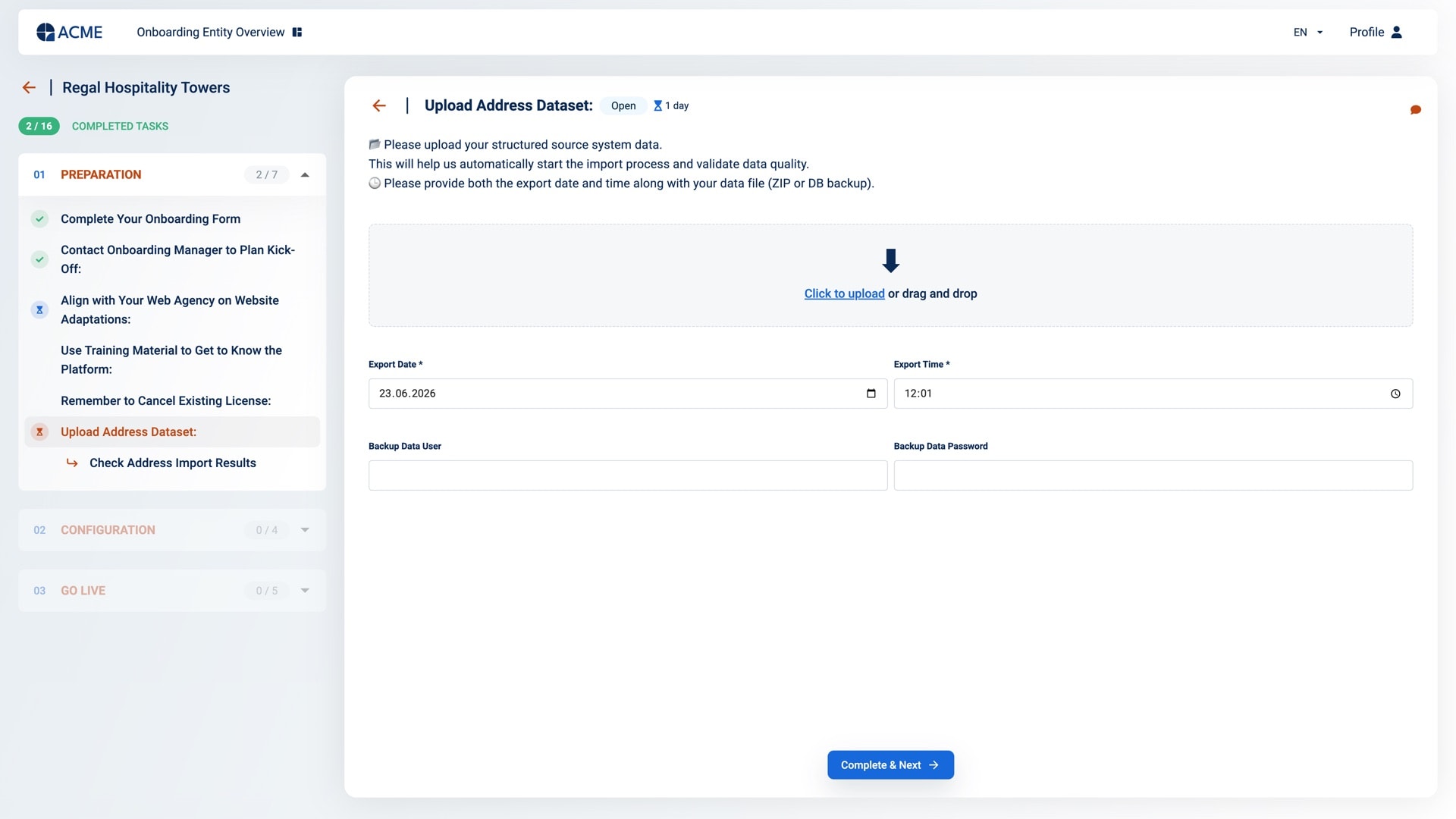
Three ways in. Upload in the client portal: databases as well as files like Excel or PDFs. An API, for example to connect your own source system directly. Or an installed CLI that connects to the source database. Every delivery is accepted first and then validated asynchronously. Problems surface with a clear reason right after arrival, not three steps later.
Micromerce combines smart solution packages with customized software. We'll show you how our software can support your business during an introductory meeting.
Further reading
From practice, shorter than a call.
Successful Data Migration: Best Practices for Effectively Migrating Your Data
Data migration is essential for modernizing IT systems, consolidating data centers, and implementing new applications. It encompasses various types, including storage migration, database migration, application migration, cloud migration, and business process migration. Challenges such as data quality, system compatibility, and security can be overcome through careful planning, the use of automation tools, and continuous monitoring. Micromerce provides comprehensive support with a powerful migration platform, proven processes, and extensive experience from over 3,000 successful projects. Companies benefit from transparent insights and efficient solutions, especially in complex migration scenarios such as mergers and acquisitions.
CRM data migration: why accounting is the hardest part
In a CRM data migration the effort does not sit with contacts and companies. It sits with the commercial records: invoices, payments, credit notes, open items and contracts. These records carry a history that may be neither altered nor shortened, and their correctness is verifiable against a single number, the balance. Nobody notices a wrong address. Everybody notices a wrong balance.
Data migration risks in a regulated environment
The main data migration risks in a regulated environment are not volume or technology. They are the burden of proof: for every migrated record it must later be traceable which source it came from, which rule changed it, and who approved that. This shifts effort out of development and into documentation and coordination, typically at a ratio of two to one against a comparable project outside regulation.
Thirty minutes on your onboarding, not our slides
 No generic demo. The first fifteen minutes are yours: your onboarding, your bottlenecks.
- We tell you if we are not a fit. Better in minute twenty than in month three.
- No gap afterwards. You hang up knowing what happens next and when.