Customer Onboarding
Client onboarding that doesn't stall on the data.
Most onboardings don't stall because of missing features or slow teams. They stall because getting customer data out of the old system and into yours is painful, and because one engineer owns the whole migration. When they are out, nothing moves.
For you if new customers wait on data before they can go live.
Looking for getting data out of a legacy system or moving an acquired customer base?
Where client onboarding actually stalls

Go-live takes 8 to 12 weeks. Every week of it costs revenue.
The data moves by hand: CSVs, SQL exports, spreadsheets over email. One slip stalls everything.
Everything waits on the one person who knows the source system.
The customer asks what happens next. The answer lives in one person's head.
Five minutes to see where your client onboarding stalls
The check places your onboarding on one of five stages, from ad-hoc to M&A-ready, and shows which of the four dimensions is holding you back. No call, no calendar.
Start the checkUp to 24 questions · about 5 minutes · free
From closed-won to go-live, step by step
One path for every new customer. Your team drives it; we step in where the sources get hard.
The signed deal opens the onboarding
The deal in your CRM starts the onboarding: pipeline, tasks and the customer portal in one place, not five tools.
The customer's data comes in
Your customer uploads in the portal, or you connect the source. AI drafts the mapping from CSV, MSSQL or API sources, and your team approves it.
Test runs until it validates
Every test import is checked in your system, so a deviation shows up before anyone goes live.
Go-live, then the next customer
The same path runs for the next customer. Our engineers take the tricky sources and train your team to run without them: 50+ projects shipped.
Did everything arrive, and is it right?
When the auditor asks about data validation: what is the basis? Where is the result? Where is it frozen? Where can I compare it?
Did every record arrive?
Records are counted per data type and location, source against target. Each location gets a go or a no-go, with the deviation named.
Do the numbers still add up?
Counts and sums are compared between source and target in every test run, so a difference shows up before anyone cuts over.
Can you prove it later?
Every run is logged with time, operator and result. Each test import is a frozen snapshot, immutable on S3 Object Lock for ten years.
What changes once onboarding stops waiting on data
From projects we run ourselves, not from a model.
2–5 weeks
to go-live, instead of 8–12
15–20%
of the deal value spent on implementation, down from 35–50%
3X
the onboardings per FTE

The European market leader in gym software on working with Micromerce:
Micromerce helped us accelerate our customer onboarding by up to 50% and significantly improve data migration quality. Their exceptional collaboration and dedication to always going the extra mile have enabled us to achieve our goals efficiently and effectively.

Konstantin Wolkowa
COO - Sport Alliance GmbH
The platform features behind this solution
Each one works on its own. These four do the work here.
Onboarding Flow Engine
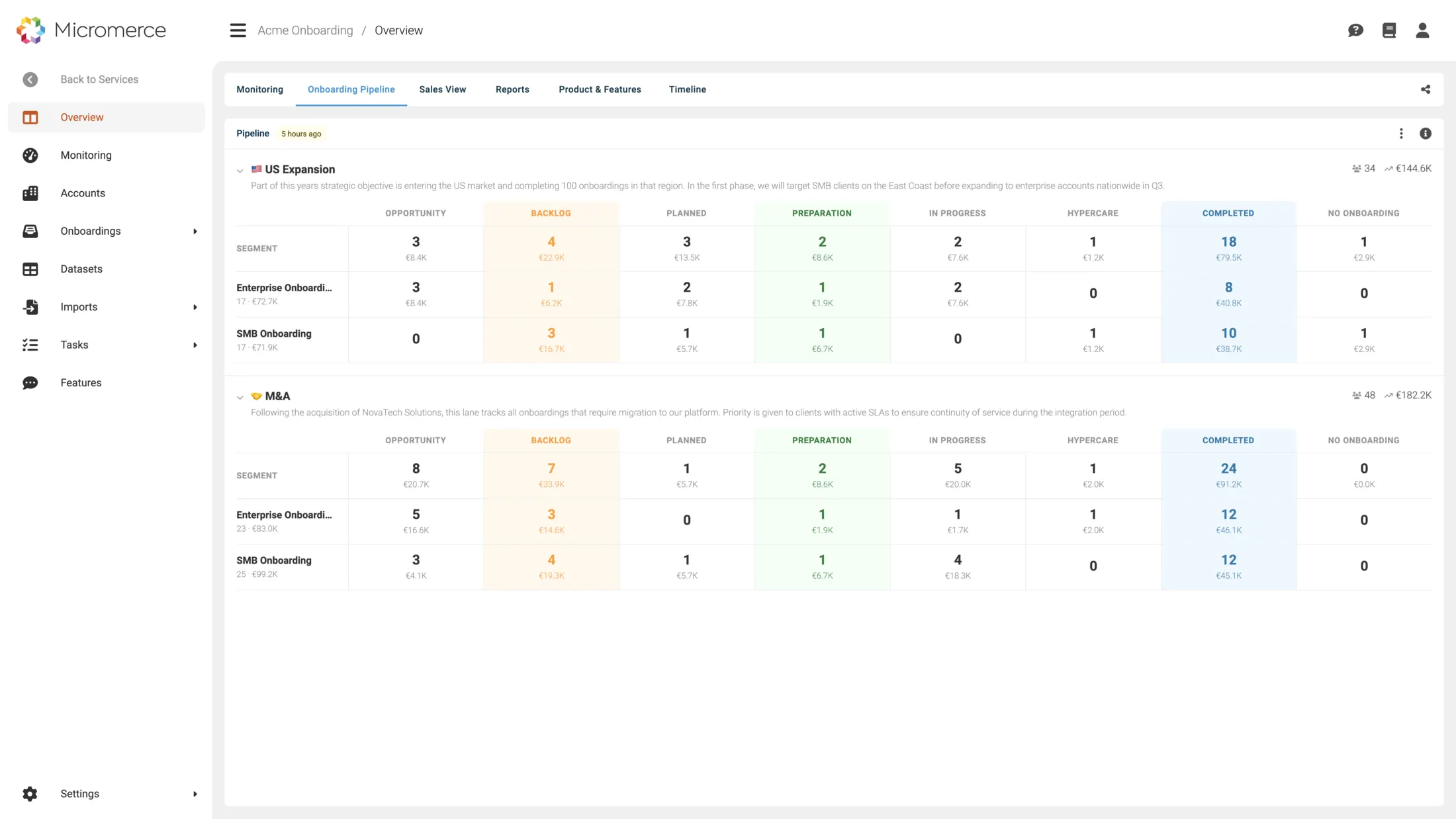
Every onboarding on one screen, from closed-won in the CRM to go-live. Pipeline view, active tasks, off-track alerts.
Client Portal
A portal in your branding that leads the customer step by step and lets them check the migration result themselves.
Analytics & Reporting
Onboarding, performance, team load and acquisition progress measured out of the box, plus AI, ours or yours, for whatever the standard views do not cover.
Customizable
Every customer on the standard platform, their differences configured on top, connected to the system you already run.
20+ data sources
without custom code
Databases, files and APIs out of the box: MS SQL, Oracle, PostgreSQL, Excel, CSV, S3.
The tools your team already works in connect the same way.





FAQs
Manual works until you need to scale. Micromerce automates extraction, transformation, validation, and import. Your team stops writing throwaway scripts and starts running a repeatable process.
Flatfile handles clean CSV uploads. Micromerce handles the messy stuff: MSSQL, SQL Anywhere, custom APIs, nested hierarchies. If your customers’ data lives in real legacy systems, that’s where we come in.
You could. But a data migration is as much a process challenge as a technical one: validation, approvals, repeatability. And the technical side is full of traps like character-encoding compatibility between systems. It takes many migrations and iterations before a system is truly robust. Micromerce brings the learnings from 10,000+ onboardings and migrations already baked in.
If you run 20+ onboardings a year and data migration is the bottleneck, Micromerce pays for itself fast. Most teams see ROI within the first quarter.
The setup itself takes hours: connecting your tools is what sets the pace, and in our experience it is done in one to two weeks. Your first migration can start on day one; we work alongside your team from the start.
Not necessarily. Those tools manage tasks and timelines. Micromerce handles the part they weren’t built for: getting customer data out of legacy systems, transformed, validated, and imported. Use both together or let Micromerce cover the full process.
Yes – you can configure templates, phases, and tasks to match your current process. You don’t need to reinvent it, just streamline it.
Yes. Micromerce connects to Zendesk, Intercom, Jira Service Desk and custom setups.
Further reading
From practice, shorter than a call.
Data onboarding: build an interface or exchange files?
The first decision in data onboarding is not file versus API. It is where the data lands: in a folder that waits for a script, or directly in a system that validates the delivery and starts the processing on arrival. We build for the second. The transport can be an upload, an SFTP delivery or an API call, depending on what the counterparty can do. Real time is an add-on, and an expensive one, so the benefit has to be checked before the complexity is bought.
A data migration plan that survives the second run
A data migration plan proves its worth in the pilot, and the pilot’s job is to test the conditions the scale-up will run under: the same process, the same tooling, the same rails as the full migration, only against a smaller slice. Learning is the deliverable, so the setup decides before the first run which result would change the plan: a run time above X, an error rate above Y, running costs above Z. A pilot built as a special case, or meant only to show that "it works in principle", teaches nothing about the scale-up and still costs six weeks.
Thirty minutes on your onboarding, not our slides
 No generic demo. The first fifteen minutes are yours: your onboarding, your bottlenecks.
- We tell you if we are not a fit. Better in minute twenty than in month three.
- No gap afterwards. You hang up knowing what happens next and when.